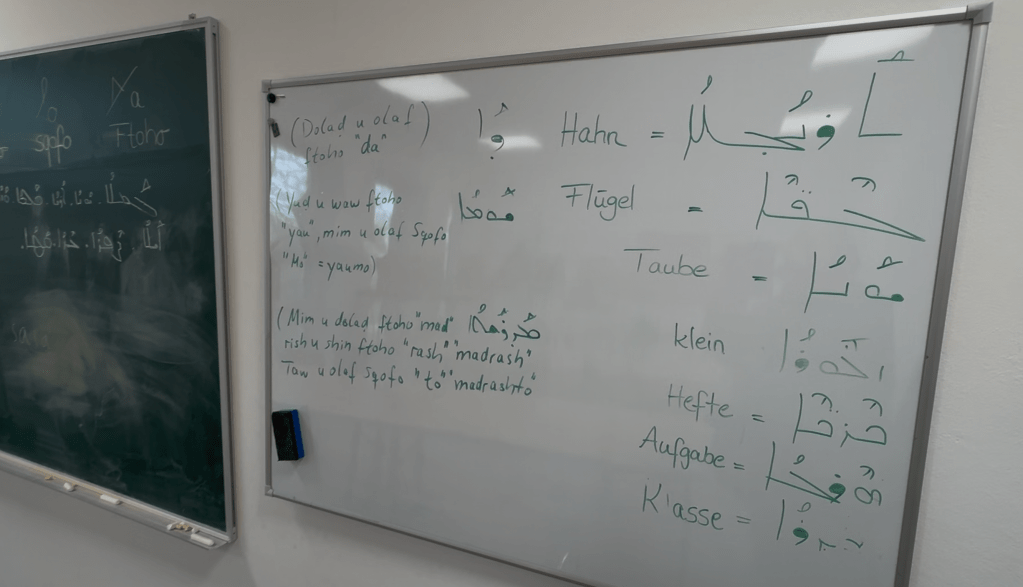
Aramaic heritage language classroom, Delmenhorst, Germany, 2026
Last month the Economist newspaper ran a briefing about the deglobalisation of culture. It presented statistics from various sectors and countries that suggest that the share of local content has been rising, particularly in digital streaming of television shows, films and music. That goes against predictions from the early 2000s. Back then the first generation of globalisation studies decried the growing dominance of American culture. Streaming, it is now argued, allows users to embrace culture closer to home. That strengthens local identities and appeals to local audiences.
Local content is usually conveyed in local languages. For languages that lack the backing of state institutions and a state economy, streaming and social media open up new user domains. That helps valorise less-resourced languages. It also puts practical instruments at users’ disposal. That gives them agency and alleviates dependency on top-down institutional measures to safeguard languages. It also allows users to congregate in trans-local practice networks. To cultivate your skills in Manx Gaelic, you don’t need to lobby local or central government for recognition and support. You don’t even have to live on the Isle of Man. It’s enough to identify fellow enthusiasts and to embrace digital infrastructure, sometimes as modest as a WhatsApp group.
Digital translation tools and voice-activated applications of various kinds are allowing more and more people not just to create, disseminate and consume content but also to manage content and transactions in local languages. The gaps are narrowing between what we can do in languages that are more powerful and have a wider digital corpus to draw on to train Large Language Models, and what is achievable thanks to emerging corpora for ‘smaller’ languages. New tools bring greater flexibility. We acquire co-ownership of a much wider scope of routines and resources. We seek reinforcement, support and inspiration far beyond the institutions that control the immediate physical space that surrounds us.
In this new world we require a new framework for community language maintenance. We need one that recognises that diverse forms of language are used for various purposes by different people and in a variety of ways. People can now claim and exercise ownership over forms of language beyond place, ancestry and proficiency. We need to move away from the idea of protecting languages as abstract entities. We should focus instead on supporting networks of actors and their local practices.
To that end we require a conceptual renewal: Starting with language itself, we need to embrace a view of linguistic pluralism not just as an individual’s cumulative knowledge of several languages but as recourse to a multi-layered repertoire of linguistic resources of various kinds: from replicating the odd greeting and reciting poems through to the ability to converse with elderly family members and on to social media literacy – the full array of what users might find meaningful for various communicative purposes. We need a view of maintenance that encompasses more than intact preservation of a self-contained language system with its rules, expressive nuances and traditional usage domains; one that instead captures the freedom, facilities, and opportunities to deploy linguistic resources selectively and dynamically. And we need an understanding of community beyond a population that shares ancestry and co-owns place, viewing it instead as a network of people who connect, punctually or regularly, physically or virtually, in pursuit of shared goals.
The leading international frameworks for language rights, the European Charter for Regional or Minority Languages and the UNESCO Convention on Cultural Diversity, both focus on legal provisions for named languages that are considered autochthonous or indigenous. Entitlement is in that way justified by a claim to authenticity and historical precedence in a designated territory. Protection is understood as ensuring historical continuity. This approach was groundbreaking at a time when national languages asserted power over minority languages and the use of regional and indigenous languages was often curtailed or even banned. But we are now in a new era, where users of disadvantaged languages face new challenges as well as new opportunities. Mobility has now replaced colonialism and nation-state formation as the key factor shaping multilingual societies.
We need a fundamental methodological rethink.
We must shift our focus away from fixed categories with essentialised indicators and on to the dynamic processes that arise through purpose-driven practice and rotating actor and action constellations. In our new world, community language maintenance does not simply mean reviving past traditions; rather, it is about embracing an assortment of practices through which people respond to multi-faceted communicative needs and opportunities.
We therefore need a functionally differentiated framework of community language maintenance. Our core unit of analysis and the target of policy interventions should be not a named language, a fixed location or a congregation of people bound by ancestry but networks of users of language resources and their shared goals and actions.
I arrive at this position after several decades of observing and analysing language maintenance efforts in a variety of settings. In the late 1980s and early 1990s I witnessed an international network of activists lobby the Council of Europe and UNESCO for resources to standardise the Romani language. That, they argued, would boost pride and recognition of this vulnerable minority population. In the meantime, however, improvised Romani literacy is omnipresent in digital communication. Users haven’t waited for top-down instructions on how to write their language or which variety to use. They assumed agency and have been tailoring their language use to their personal, local needs and to available infrastructure. In Matras & Reershemius (1991) we described how standardisation efforts take place beyond the state for languages like Romani, Kurdish and Yiddish thanks to the efforts of influential actors and their networks. In Matras & Leggio (2017) we showed how users of Romani cluster around social media content using different dialects and orthographic representations. I described this process of de-centralised codification in Romani in several other works (Matras 1999, 2015, 2021) including a paper commissioned by the Council of Europe’s Language Policy Division in which I made the case for a policy of linguistic pluralism (Matras 2005a).
In Matras (2005b) I took a somewhat reserved stance towards linguists’ ambition to salvage endangered languages. I described how among English Gypsies (who use a contained vocabulary of Romani origin in an ethnolectal form of English) individuals developed an interest in acquiring greater proficiency in Romani in order to engage in religious missionary activities among Roma immigrants from eastern Europe. That revitalisation attempt was limited to a small circle of church functionaries, aimed at a particular transaction. For the linguist, community-oriented engagement meant in this case putting professional skills at the disposal of a specific interest group. By contrast, my work to document the Domari language in Jerusalem would not have been possible had it been a pre-condition for the project that a community collective articulate an interest in language preservation (such was the policy of some research funding bodies); the few remaining speakers in this poor and marginalised community had other, more pressing priorities.
Together with my collaborators on the Multilingual Manchester project I undertook a critical examination of the notion of ‘community’. We demonstrated how communities emerge as networks of users that can transcend place and embrace language for a variety of practices, some constitutive of their shared action routines and others merely symbolic or performative. We demonstrated how among migrant populations community pre-occupation with a heritage language serves as a diasporic stance (Matras & Gaiser 2020a, 2020b, Matras et al. 2022, Goldstein & Matras 2025). We showed how street-level bureaucrats and their clients assume agency for mutual accommodation drawing on their wider repertoires of language experiences (Matras, Tipton & Gaiser 2023). We proposed that linguistic pluralism and awareness of variation should be at the core of community language maintenance (Matras & Karatsareas 2020).
My call for a functionally differentiated framework for community language maintenance is also anchored in my interest in theorising contact and its effect on the structure of language. In my book Language Contact (Matras 2009/2020) I described multilingualism as the deployment of an integrated complex repertoire of linguistic resources. Managing the multilingual repertoire is an interplay of factors: accommodation to a setting and context (by selecting certain forms for use while inhibiting others), the wish to exhaust the repertoire’s full expressive potential, and the urge to reduce the processing effort required to maintain separation between languages around certain functions, for example discourse markers, by generalising one set of forms across all interaction settings. These pull factors compete and ultimately determine how notional demarcation boundaries are redrawn within the repertoire, giving us observers of language the impression that one language system ‘borrows’ structures from another. Practice routines, not systems, are at the core of that theoretical outlook (cf. Matras 2024b). In my work on urban multilingualism I extended the concept of dynamic repertoire deployment to networks of users, treating place as a site of encounter rather than of provenance and entitlement (Matras 2023, 2024a, 2024c).
Recently, I have taken an interest in the wider epistemological implications of searching for the dynamic interplay of practice, agency and networking instead of focusing on rigid categories (Matras 2024d, forthc.). I proposed to rethink notions like ‘native speaker’ by de-coupling acquisition sequence from proficiency and a sense of ownership of language; and to reconsider ‘heritage language’ by separating the meaningfulness of resources to an individual user from blood-lines. I suggested to define categories like Mixed Languages, Creoles and Lingua Francas not on the basis of fixed structural indicators but through the underlying processes that bring together distinctive actor constellations and repertoire resources in pursuit of particular communicative goals.
It is that reflection that prompts me to call for a new approach to safeguard minority languages. I propose that we abandon the fixation with labelled languages, essentialising indicators and ownership provenance. We should instead focus on repertoires, the deployment of linguistic resources in specific action constellations, and revolving, dynamic agency.
References
Goldstein, Piotr and Matras, Yaron. 2025. Language as a diasporic stance: Polish in a migrant urban space. Journal of Ethnic and Migration Studies 51: 1143-1159. https://doi.org/10.1080/1369183X.2024.2368846
Matras, Yaron. 1999. Writing Romani: The pragmatics of codification in a stateless language. Applied Linguistics 20-4, 481-502.
Matras, Yaron. 2005a. The future of Romani: Toward a policy of linguistic pluralism. Roma Rights Quarterly 1:31-44.
Matras, Yaron. 2005b. Language contact, language endangerment, and the role of the ‘salvation linguist’ In: Austin, Peter K. ed. Language Documentation and Description, Volume 3. London: Hans Rausing Endangered Languages Project. 225-251.
Matras, Yaron. 2009/2020. Language contact. [second edition]. Cambridge: Cambridge University Press.
Matras, Yaron. 2015. Transnational policy and ‘authenticity’ discourses on Romani language and identity. Language in Society 44:3, 295-316.
Matras, Yaron. 2021. The standardization of a stateless language. In: Ayres-Bennett, Wendy and Bellamy, John. eds. The Cambridge Handbook of Language Standardization. Cambridge: Cambridge University Press. 645-664
Matras, Yaron. 2023. The city as multilingual utopia. Creating decolonial spaces for language in an urban setting. In: Levkovych, Natalya. ed. Diversity in Contact. Berlin, Boston: De Gruyter. 369-438. [pre-print]
Matras, Yaron. 2024a. Speech and the city. Multilingualism, decoloniality and the civic university. Cambridge: Cambridge University Press.
Matras, Yaron. 2024b. Reconciling the global and local in language contact. In: Pfadenhauer, Katrin, Rüdiger, Sofia and Serreli, Valentina. eds. Global and Local Perspectives on Language Contact. Berlin: Language Science Press. 333–347.
Matras, Yaron. 2024c. Epilogue: Agency, Ideologies and the Continuum of Language Practices – Towards an Integrated Theory. In: Arendt, Birte & Reershemius, Gertrud. eds. Heritage Languages in the Digital Age: The Case of Autochthonous Minority Languages in Western Europe. Bristol: Multilingual Matters. 211-217. [uncorrected proof]
Matras, Yaron. 2024d. From multilingual repertoire to language change: A critical approach to feature spread, borrowing and language ecology. In: Bradley, D., Dziubalska-Kotawczyk, K., Hamans, C., Lee, I., Steurs, F. eds.Contemporary Linguistics: Integrating Languages, Communities and Technologies. Brill. 127-136.
Matras, Yaron. forthc. From category essentialism to process dynamism. Reconsidering theory in contact linguistics. In: Drinka, Bridget, Terttu Nevalainen & Gijsbert Rujen. eds. Handbook of Historical Sociolinguiscs. Berlin: De Gruyter. [pre-print]
Matras, Yaron, and Leonie Gaiser. 2020a. Re-visiting ‘community language’: Arabic in a Western global city. In: Mar-Molinero, Clare. ed. Researching Language in Superdiverse Urban Contexts: Exploring Methodological and Theoretical Concepts. Celevdon: Multilingual Matters. 52-78.
Matras, Yaron, and Leonie Gaiser. 2020b. Defining the position of ‘community’ in the study of linguistic landscapes. Linguistic Landscape: An International Journal 6:2, 109-127.
Matras, Yaron, Leonie Gaiser, Katie Harrison, and Stephanie Connor. 2022. Actors’ discourses on Language Supplementary Schools: Diaspora practices and emerging ideologies. Journal of Multilingual and Multicultural Development 45(5), 1703–1716. https://doi.org/10.1080/01434632.2021.2020801
Matras, Yaron, and Petros Karatsareas. 2020. Non-Standard and Minority Varieties as Community Languages in the UK. Towards a New Strategy for Language Maintenance.
Matras, Yaron, and D. Viktor Leggio. 2017. Orthography development on the Internet: Romani on YouTube. In: Jones, M. C. & Mooney, D. (eds.). Creating Orthographies for Endangered Languages. Cambridge: Cambridge University Press, 254-275.
Matras, Yaron, and Gertrud Reershemius. 1991. Standardization beyond the state: The cases of Yiddish, Kurdish and Romani. In: von Gleich, U. & E. Wolff (Hrsg.). Standardization of national languages. Hamburg: UNESCO-Institut für Pädagogik. 103-123.
Matras, Yaron, Rebecca Tipton and Leonie Gaiser. 2023. Agency and multilingualism in public health care: How practitioners draw on local experiences and encounters. In: Beeler, B., Gaibrois, C., Lecomte, P. and Vigier, M. eds. Understanding the dynamics of language and multilingualism in professional contexts: Advances in language-sensitive management research. Cheltenham: Edward Elgar. 26-60.

