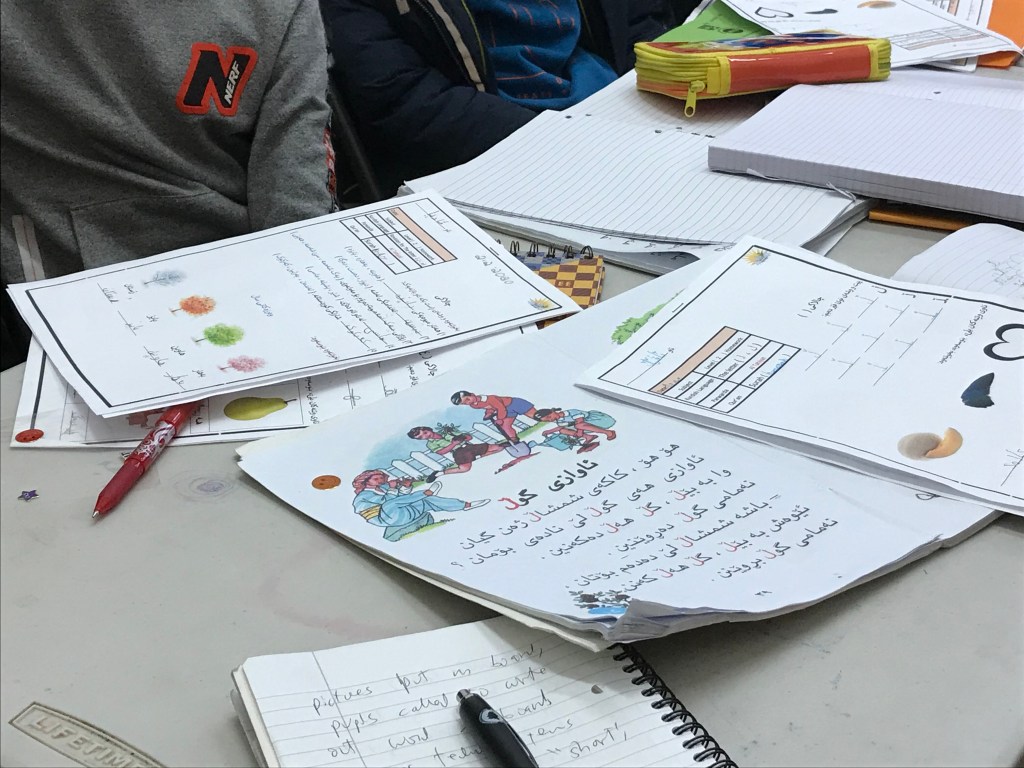
Kurdish supplementary school in Manchester, 2020
What current issues face UK language policy, who are the principal actors in UK language policy, and what drives policy making on language?
These and other questions are on the agenda of a Roundtable Discussion on ‘Multilingualism, Identity and Ideology’ convened by Professor Ioanna Sitaridou at Queens’ College, Cambridge University in which I have been invited to take part. I write these lines ahead of that conversation. I have written previously and rather extensively on UK language policy in my book Speech and the City: Multilingualism, Decoloniality and the Civic University (2024). A brief synopsis of the book is available in my blog post Britain’s Cities are Multilingual, but Utopian Visions of Equality are Being Cancelled. I approach policy as institutional practice that links needs, goals and ideologies that actors employ to justify choices.
One of the issues that the Cambridge Roundtable wishes to touch on is the so-called Chief Linguist initiative that is associated with the Open World Research Initiative (OWRI), a four-year multi-site research scheme funded by the Arts and Humanities Research Council (AHRC) between 2016-2020. I was involved in that scheme in a senior role as leader of the research strand on Multilingual Communities, one of three strands of the consortium Cross-Language Dynamics: Re-Shaping Communities. That strand, based at the University of Manchester, revolved around my project Multilingual Manchester (2010-2021), a dynamic enterprise that brought together research, teaching and public engagement, breaking boundaries among academic disciplines, between teaching and research impact, between staff in research and support roles, and one might even say between academic work and social activism.
Multilingual Manchester put a spotlight on language pluralism in cities. It pioneered a student volunteer scheme in community hubs and public service providers around the theme of multilingualism and an online archive of student research on linguistic diversity in the city. It built stakeholder communities like the Supplementary School Support Platform for community-led home language schools. It produced digital resources such as the LinguaSnapp mobile app and interactive online map to document multilingual signage in public spaces, and the Data Mapping Tool to triangulate statistical datasets on language and inform about the linguistic profiles of city districts. It used public spaces to raise awareness of multilingualism through annual grassroots events. It initiated direct interventions with policy makers such as drafting a City Language Strategy and campaigning for a change to the wording of the Census question on language to allow more coherent and inclusive consideration of heritage and home languages and language skills.
The project’s success can be measured in generations of students who benefited from their involvement in it to shape future career trajectories, local community institutions and service providers that benefited from staff and student input, a city that branded itself ‘Britain’s City of Languages’ inspired by the project’s activities, numerous digital and publication outputs, extensive media coverage and international replication of the project’s key intellectual and organisational elements and their adoption into local enterprises around the world, among many others.
The fact that Multilingual Manchester’s work resonated with so many stakeholders testifies to a need for a dedicated focus on the country’s multilingual cities, not least from a policy perspective. Its treatment by the wider community of Modern Languages Research, or those who purport to speak on its behalf, and by a number of government institutions, however, testifies to the jealousy and the nationalistic sentiment that characterise British institutions and policymaking in the aftermath of Brexit.
In Speech and the City I pointed out the absence of a centralised, clearly formulated UK policy on language. Instead, language policy was described as a patchwork of loosely connected acts. But it is nevertheless possible to divide UK language policy into three discourses. (I disregard for the purpose of this essay gatekeeping elements of language policy such as setting a threshold for English proficiency as a condition for naturalisation or the use of Language Assessment for the Determination of Origin to verify claims for asylum).
The first of those might be defined as the Indigenous Regional Languages discourse. I use that term although I very much dislike the notion ‘indigenous’; it means essentially: “My ancestors were here before yours and therefore I can claim authenticity in this particular territorial space, which entitles me to certain privileges”. I have seen this kind of argument cause division, distress, exclusion and disparity. But again, for the purpose of this essay, let’s accept a benevolent reading of ‘indigenous’ as the effort to promote aspects of the cultural heritage linked to minority communities that populate particular geographical regions.
In the UK, the Celtic languages receive varying levels of policy support. They range from the national Welsh Language Act that regulates language rights in the territory of Wales and across the country as a whole (obliging certain government agencies to communicate in Welsh where there is demand), through to devolved government and local authority initiatives in Scotland to use Scottish Gaelic in broadcasting, public signage and education, on to contested political initiatives to afford Irish an official status in Northern Ireland, and finally to local authority and grassroots initiatives that promote awareness, acquisition and use of Manx on the Isle of Man and Cornish in Cornwall. The regional focus of these activities necessarily contains their scope while on the other hand lending it a role that is more often than not accepted as complementary to rather than challenging national identity (notwithstanding the fact that it may also be embraced by separatist ideologies where such exist).
The second might be called the Multilingual Society discourse. It works to tackle linguistic inequality in society and towards greater linguistic justice. It promotes awareness of language in recognition of the fact that we live in a multilingual society. Multilingual Manchester represented this discourse, along with other academic initiatives that have embraced notions like ‘translanguaging’ and ‘superdiversity’ as a direct challenge to prevailing language hierarchies and which call for societal reform. On the ground, multilingual ideologies and strategies are being implemented by community-run weekend language schools (supplementary schools), local libraries that stock materials in multiple languages, NHS Trusts that allocate significant budgets and procurement effort to interpreting and translation services, community organisations that teach English to new arrivals, and more.
The Multilingual Society approach is a civic language discourse that differs in some fundamental aspects from the Indigenous Regional Languages discourse. Rather than claim historical precedence it conjoins belonging to a place in the here and now with personal and intergenerational recollection of migration referencing the remote there and then. It is intrinsically trans-local and trans-national. It rejects the view that multiple forms of identity are inauthentic, contradictory or illegitimate. Its message is one of plurality and permanent fluctuation. It adopts a looser and more dynamic notion of ownership and links it to practice rather than to provenance.
In the recent parliamentary by-election in the Gorton and Denton district of Manchester, a video in Urdu produced by The Greens was criticised by rival parties as being ‘sectarian’ because it appeared in a language other than English. I personally welcome the use of migrant languages in the political campaign. What I despise as sectarian in that particular video is not the choice of language but the content, as it used pictures of India’s Modi and Israel’s Netanyahu to insinuate that the Labour government was working into the hands of the enemies of Muslims. Hate speech is wrong, even if delivered in Urdu; but it is wrong because it’s hate speech, not because it’s in Urdu. The controversy is a perfect illustration of how the English-only discourse claims control over the public space. The Multilingual Society approach in its many facets addresses linguistic inequality and seeks ways to achieve greater linguistic justice. To that end, it demands and where possible, it tries to implement reform that goes against hegemonic trends.
On the opposite end stands the third discourse, which I will dub somewhat endearingly yet not forgivingly the Rule Britannia discourse. Its roots go way back but as far as I can bear witness from my personal perspective, they emerge in the aftermath of the Labour government’s decision to abolish the compulsory study of modern foreign languages at GCSE (intermediary secondary school) level in 2004. The goal was to cleanse the curriculum of the subject that students found most difficult and where they achieved lowest scores, in a bid to artificially raise attainment levels. The knock-on effect was a decline in enrolment in modern languages at university level. When the neoliberal rationale for higher education degrees took firm control through the raising of university tuition fees in 2010 and universities began to market degree courses as commodities that would increase graduates’ earning potential, low enrolment became synonymous with rationalisation. This put modern language departments in a state of anxiety about their future.
The AHRC’s OWRI scheme was a response to that anxiety. A conglomerate of modern languages departments was being challenged to persuade policymakers that they were worth further investment to avoid the cull. This coincided with the outcome of the referendum on EU membership in 2016. Those who put themselves at the head of OWRI – professors of French and other European languages from several of the country’s elite universities – decided to embrace the policy discourse of the day in order to get policymakers’ attention. They set out to convince policymakers that Brexit offered not just an opportunity but a necessity for language learning: It would help cement a Global Britain which, now independent of the EU, would pursue its own interests in security, defence, and overseas trade. The meaning of the phrase ‘soft power’ was inverted to designate the advantage that Britons acquainted with other languages would have over competitors, in a philosophy that regards other nations intrinsically as competitors rather than equal partners.
The ideal target audience of language teaching in this scenario was the white English middle-class individual of monolingual family background, educated at an elite university, who would take on a role in the civil service – Whitehall’s recruits. It was the modern Lawrence of Arabia, who would use language skills to gain the trust of overseas populations as a way of forwarding imperial interests. Proponents of the Rule Britannia discourse embraced phrases like ‘progressive patriotism’ to appeal to a nationalistic agenda. They found sponsors in members of Parliament who expressed concerns about high levels of immigration. Their appeasement efforts culminated in the proposal that a Chief Government Linguist should coordinate language teaching based at GCHQ (Government Communications Headquarters), the government’s spy agency. Languages were pitched as a way of protecting us from others, not as a way of acknowledging and servicing our own society’s internal diversity.
In theory, these three discourses of language policy are not incompatible with one another. But the Rule Britannia discourse not only appeals to hegemony, it also seeks to impose hegemony. My personal experience testifies to that. Manchester’s application to the OWRI scheme was based on my idea to set up a project around Multilingual Manchester with a focus on multilingual communities. Only after the proposal had been submitted and approved did I find out that the person who had used his position as School Research Director to nominate himself as designated Principal Investigator, Professor of Russian Stephen Hutchings, had included in the bid a clause that would ensure that at the end of the scheme Multilingual Manchester would lose its distinct focus – euphemistically phrased as a move ‘beyond its sociolinguistic specialisation’ – and become a Centre for Modern Languages under his direction. I also had to resist pressure from Hutchings to present Multilingual Manchester as a potential venture to tackle extremism and radicalisation (which is what he associated with our links with communities that spoke Urdu, Kurdish, Arabic and Persian) and that it would support the Brexit agenda by forging links with India (I’m still not sure what the rationale entailed).
When I expressed a wish to contribute to the OWRI series of policy briefings (controlled by Cambridge-based Wendy Ayres-Bennett and Belfast-based Janice Carruthers, both professors of French) Hutchings sabotaged that effort by writing to Carruthers to advise that working with me would be a way of “dispelling his paranoid delusions about you” while at the same time advising: “he is going through a particularly unpleasant and disruptive phase at the moment and is proving something of a nightmare to deal with. This doesn’t mean to say he wouldn’t behave in the context of a policy briefing (he is, believe it or not, quite capable of this, from time to time!) but I would be deceiving you if I said there wasn’t a risk. Or you could just not reply and hope he forgets.” From her side, Carruthers (at the time also responsible for Modern Languages on behalf of the AHRC) not only declined to accommodate a policy briefing on city multilingualism but also blocked the use of OWRI communication support for our campaign to amend the Census question on language. I was advised that “we shouldn’t antagonise civil servants” and that the best approach was a behind the scenes advance by Cambridge staff to Cambridge graduates. These British-born colleagues whose interest was limited to European languages not only shied away from embracing a broader and more inclusive linguistic agenda, they also claimed sole and exclusive ownership over the public engagement space around languages and the access to policymakers.
When I expressed scepticism around the Chief Linguist initiative, asking for evidence that a similar position had brought about results in other settings and questioning the proposal to accommodate it with the security services rather than in the domain of culture, communities, education or even in an overarching inter-ministerial department, I was declared to be the enemy from within, the OWRI scheme’s Emmanuel Goldstein. For starters, I was banned from participating at the Westminster event at which the proposal was publicised. Hutchings then widened his campaign of personal defamation to discredit me and my intentions. He wrote to Maggie Gale, his successor as School Research Director, saying about me: “He conducts vendettas against anyone whom he considers a threat to his narcissistic view of the world”. He went on to write: “Yaron is outrageous and so malicious“, “he is out of control”, “he is mercurial and unpredictable”. He opened one of his messages with the words “more disruptive activity from Yaron to report” and communicated in another that it was important to “not allow him to muddy the waters with his propaganda”. He then described me as “cunning” because in a draft blog post which I had shared with him in confidence to obtain his feedback, I had “slipped in a paragraph about a call to the government to appoint a Chief Linguist. The tone is snide and negative. He is entitled to his own view, of course. [here three lines were redacted by the University of Manchester – I can only imagine what they contained]. If I were to approve the posting of Yaron’s blog with this paragraph I would be breaching the trust of the AHRC and my fellow PIs”. In response, I was instructed by Gale: “Stephen Hutchings has absolute editorial veto on any and all communications linked to the project and its works. You must not bring the university’s reputation into disrepute through communications which in fact reflect your own opinions”.
In the neoliberal university, the reference to ‘bringing the university into disrepute’ is of course a threat with dismissal for gross misconduct. Universities budget to pay compensation to staff who were unfairly dismissed and later won an appeal to the employment tribunals. The threat was therefore not idle. This was the academic institution curtailing my academic freedom in relation to my professional views as a researcher about current discussions surrounding UK language policy. The threat was made on behalf of a group of researchers in European languages who had embraced the nationalist political line of the day – the Rule Britannia discourse – and who acted jealously and with xenophobic undertones to protect their privileged positions and exclusive access to policymakers and policy debates. It was a betrayal of the principles of free expression and debate, of enquiry and of evidence-based policy discussion. The Rule Britannia crowd was acting not just to forward the interests of their own departments’ survival, they were also acting as a counterforce to anything that might disrupt the hegemonic order, anything that interrogated prevailing language hierarchies, that sought reform and linguistic justice.
In the following year Hutchings’ defamation campaign continued to intenfisy and widen. He made cynical use of a blog post that I had published in which I alluded to anti-Jewish incidents that I had experienced at the university many years earlier to try to convince managers that I was disloyal to the institution and a threat from within – itself a classic antisemitic trope. In the wake of these attacks and as I grew weary of the persistent ambushing and threats, I chose to make use of the opportunity offered during the Covid crisis to take voluntary severance and early retirement from my post at the University of Manchester. After I left, Hutchings published a report on behalf of the OWRI consortium that contained my name and photo without my consent. It presented disinformation about the project and the research that I had led. It claimed, for example, that the project “set up the country’s first digital translation platform at Manchester Museum” and that it had set up a “website with residents’ testimonials of their multilingualism”. Both claims were false, as the University of Manchester later admitted, though it took another three years to remove the report from its website. When the report was first published and I complained to the University, internally, and asked to correct that information, I was accused of trying to damage Hutchings’ reputation. In an act that can only be described as vandalism, the University of Manchester then went on to delete almost all the digital resources created by Multilingual Manchester, including the LinguaSnapp interactive map of linguistic landscapes (with contributions by dozens of students and research collaborators), reports from student volunteers, calls for a Multilingual Cities Movement, reports on events and conferences as well as valuable language databases on Arabic, Kurdish and Romani funded by millions of pounds in grant money from national and European research councils. The path of destruction signalled more than just lack of respect for knowledge and academic achievement; in context it appeared to be an act of vengeance.
There is a sequel. While the government has decided not to proceed with appointing a Chief Linguist it has nevertheless handed over the lead on Languages to GCHQ, which collaborates with the British Council and the Department for Education. Together they have set up the National Consortium for Languages Education (NCLE). Its stated goals are to raise the profile of languages and strengthen language learning, but its work seems strongly linked to the government initiative to limit language teaching to a set of selected ‘excellence hubs’ of secondary schools across the country, reinforcing the vision of languages as an elite subject tailored to the ambition to recruit skilled civil servants for overseas operations.
In April 2024 I was invited to speak to the All-Party Parliamentary Group on Modern Languages about my work in Manchester, on behalf of the group Manchester City of Languages, which continues the legacy of Multilingual Manchester (and has received threats from the University of Manchester which insists that it has the sole right to claim possession over my legacy). Along with several other groups represented at the event we decided to set up a network of multilingual city initiatives. Innocently and somewhat naively we welcomed the proposal by a British Council official and a support worker for the APPG, both of whom are also members of the NCLE, to assist us in coordinating our meetings.
In parallel I was personally approached by officials from GCHQ and invited to have a conversation about possible collaboration. I attended the meeting on my own, and faced some twelve officials from various government departments. Their demeanour was frozen, two of them leading the questioning. I am not easily intimidated and I adore speaking to strangers about my work, and do so passionately, but this was not a pleasant experience. I was unable to discern what it was precisely that they wanted to know and where they saw possible collaboration.
As the network of multilingual cities progressed, I proposed that we might compose and publish a kind of generic template for a City Language Strategy (inspired by the one we had published for Manchester). I pursued this together with other members of the network. But when we presented our draft the initiative was abruptly rejected; in parallel I received a somewhat ominous message from the GCHQ officials saying that they saw no scope for collaboration after all. Within a few months it turned out that the two officials from British Council and APPG (both NCLE members) who had put themselves in charge of our multilingual cities network had removed me from the mailing list of further meetings, in effect excluding me from the network that I had co-initiated.
I am not entirely sure how to interpret these events. But someone out there is scared of the Multilingual Society policy discourse and regards it as a threat. The same forces who act as a counterforce to the Multilingual Society are the ones who zealously promote the Rule Britannia language discourse – languages as an exclusive, elite skill with which to equip civil servants in order to forward British overseas interests. I enjoyed the film Lawrence of Arabia with Peter O’Toole, Omar Sharif and Alec Guiness. I’m not sure I like the contemporary unfolding of the story.
Note: Redactions of the accompanying documentation were carried out by the University of Manchester
 Yaron Matras