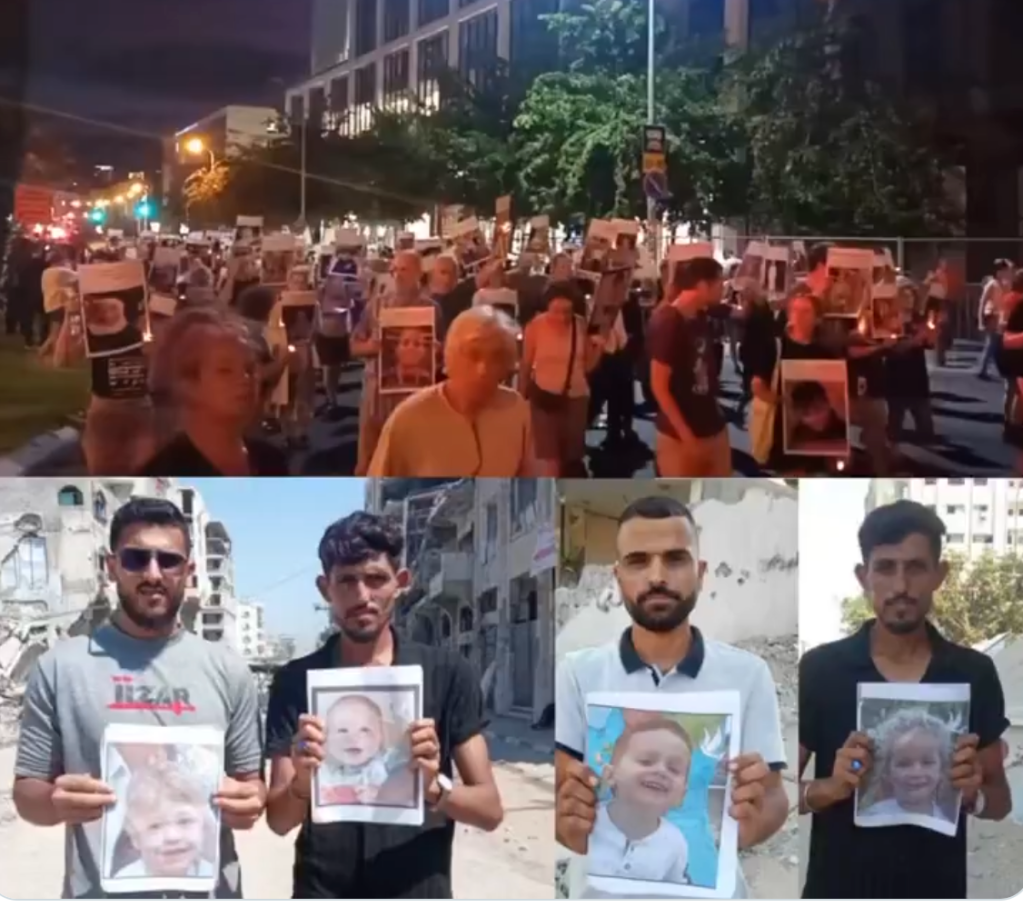
Gaza conflict, July 2025: Israeli protestors in Tel Aviv carrying images of Palestinian child victims and Palestinian protestors in Gaza carrying images of Israeli child victims (images from @HenMazzig)
I recently attended a social gathering of international academics who get together occasionally to watch films. This time, the suggested piece was Gaza Sound Man. Promoted as a documentary about the current situation in Gaza, the 44-minute film was produced by Al-Jazeera network and released in February 2025. It has since been shown at various documentary film festivals and is offered by Amazon and Vimeo as part of their streaming portfolios. The marketing text and trailer describe it as a record of ‘the sounds of life, the sounds of death’ of the people of Gaza since 7 October 2023 and as aiming to ensure that ‘the sound of the people of Gaza is heard’. The wordplay ‘Sound Man’ and the imagery of the narrator/director walking about carrying over his shoulder professional audio equipment (which, however, he does not seem to deploy) are there to deputise the cause of those who suffer inescapable injustice while lacking a voice.
On that particular evening we did not, however, get a chance to see the film. Tensions arose as soon as the Al-Jazeera logo appeared on the screen. In 2024, in response to its pro-Hamas coverage Al-Jazeera’s broadcasts were shut down, in a rare sign of harmony, both by the authorities in Israel and by the Fatah-controlled Palestinian Authority in the West Bank. Once the logo was gone, some participants preferred not to have to watch scenes of war while others decried that such reservations were only articulated when the subject was the Palestinian people. In the storm of the argument, a cup and a salad bowl were inadvertently knocked over.
On the day after the gathering I phoned my mother, who lives in Israel. She told me how she had spent the early hours of that morning in the shelter after warnings were broadcast of missile attacks from both Hamas in Gaza and the Houthis in Yemen. It was a reminder that twenty months after Israel launched a massive retaliation attack that has flattened much of Gaza, Israelis continue to be vulnerable to indiscriminate attacks, having to rely on Israel’s interception counter measures and civil defence infrastructure. Despite the blatant imbalance in military power, this remains a war between two active military sides, both of which threaten civilian lives.
Amidst the images of devastation and despair, the past months have also seen the coordinated appearance of Israelis marching on the streets of Tel Aviv carrying pictures of Palestinian children who lost their lives in the bombing of Gaza, with Palestinian residents of Gaza posing with photos of Israeli children killed by Hamas on or after 7 October 2023. This act of bridging the divide across the war zone is perhaps the boldest statement yet aiming to replace rage with nuance, self-centred righteousness with real empathy and hostility with humanity. The two ‘sides’ of the conflict are, in this perspective, not defined by their position along the war zone’s demarcation lines nor by their ethnicity, language, religion or citizenship; rather, people can choose a ‘side’ by jointly advocating a future of partnership and co-existence.
Opposition to the war in Gaza is growing in Israel, with polls suggesting up to 60% in favour of stopping the war now. Reports continue to flag how senior figures like the serving Chief of the Armed Forces, the serving Attorney General, and former Military Generals and Prime Ministers strongly oppose strategies proposed by Prime Minister Netanyahu and his right-wing nationalist coalition partners even going as far as to call them potential war crimes. There is no unity in Israel about what to do in Gaza or how, nor about what long-term ends any tactics should pursue. Israel as a functioning state can and should be held accountable for the actions of its armed forces on the ground; yet it is unrealistic to assume that it has a coherent vision for the future or even a middle-term plan. Israel’s leadership has been improvising with a mixture of self-defence, deterrent, revenge, political survival, populism and regional opportunism that has created unprecedented polarisation within Israeli society, not least around concerns that the government has been neglecting the fate of the Israeli hostages held captive by Hamas.
Meanwhile on the Palestinian side, the period May-July 2025, coinciding with Israel’s controversial attempt to re-structure yet again the modes of delivery and distribution of humanitarian aid to Gazans, saw a further rise in open protests by Palestinian residents of Gaza against Hamas. They accuse the organisation of hijacking the local population and triggering the Israeli retaliation that has brought about destruction, displacement and misery to the point of starvation. At the political level, international Palestinian-led initiatives like Realign for Palestine have sprung up denouncing Hamas and arguing that its attacks on 7 October have ‘proved the futility of violent armed resistance, with innocent civilians paying the highest price’. The group calls for a two-state solution declaring that ‘Palestinians and Israelis each have legitimate grievances, valid histories, rights, and aspirations’ and calling to ditch threatening slogans like ‘globalise the intifada’ and ‘from the river to the sea’ (both inherent to the group-code of Palestine solidarity campaigns in the West) arguing that such slogans risk keeping people apart and destroying opportunities for peace.
Elsewhere, too, the war in Gaza has become a watershed moment in various respects. In the UK, a new political party, provisionally called Your Party, formed in July 2025 bringing together former Labour and independently elected Members of Parliament. At the time of writing, the party, which boasted over 400,000 sign-ups within just three days of its formation, was campaigning on just two political programme points: protection of the welfare safety net, which they view as being under attack by the Labour government, and the call to ‘stop the genocide’ in Gaza. It is the first time, to my knowledge, that a political party has formed substantially around a single foreign-policy issue (Brexit having been a matter of fundamental domestic relevance, economically and constitutionally). Clearly, the party regards Gaza as an emotive momentum that can be mobilised to ensure electoral success. There is little doubt that Britain’s announcement on 29 July 2025 that it would (probably, most likely, or perhaps, unless conditions changed …) recognise a Palestinian State was driven in large part by the hope to contain the exodus of supporters from Labour to the new political party.
How we think about Gaza thus has the potential of shaping not just how we think about the Israel-Palestine conflict but also about a wider range of regional, international and domestic political questions. I wish to propose a kind of taxonomy to help us understand current approaches to the war in Gaza. There are, I suggest, three distinct perspectives:
The first implies, albeit passively, that the events of 7 October 2023 are irrelevant to the current situation in Gaza. Such is the position taken by the film Gaza Sound Man and by much of the daily media around the world. It places the focus on the suffering of the people of Gaza under Israel’s attacks. It promotes an emotive identification from which it derives the demand for a unilateral ceasefire and humanitarian aid. It sidesteps both the causes of the current situation and long-term remedies. Nonetheless, while doing so it inevitably and consciously stirs up hostility against those whom it considers to be the sole perpetrators, namely Israel and its backers. It is a political stance, camouflaged as a mere humanitarian concern. At the legal-political level, South Africa’s application to the International Court of Justice equally avoids explicit connection to the 7 October attacks and sets the scene in the hour on which Israel’s response began, litigating the cause for ‘genocide’,. It seeks to impress on the court and on public opinion that 7 October merely provided convenient timing for a pre-conceived plot to wipe out the Palestinian population of Gaza.
The second perspective is anchored in a more overt argumentative approach to history. As such, it is split along the two ethnic-national ‘sides’ of the conflict. This stance maintains that the events of 7 October 2023 were merely a single discrete incident representing a century-old continuum of violent conflict. A purportedly ‘neutral’ sample is the statement released by UN Secretary General Guterres in late October 2023. While condemning the Hamas attack as a ‘horrific’ act of ‘terror’ he stated that it ‘did not happen in a vacuum’. On the pro-Palestinian side, proponents of this approach take the view that 7 October was an act of resistance against an ongoing Israeli occupation of Palestinian lands that began more than seventy years ago. This theme is commonly heard in speeches, interviews and on social media, downplaying and sometimes even justifying (and in the more extreme cases, glorifying) the Hamas massacre and calling into question the legitimacy of Israel’s reaction to it. This standpoint has a counterpart on the pro-Israeli side of the conflict. Here, 7 October is regarded as yet another expression of the century-old refusal by Arab nations to accept Jewish self-determination in the historical Land of Israel, or indeed as yet another violent act of antisemitic hate, acts that have been appearing periodically throughout history and, it is expected, will continue to appear, making it futile to seriously deliberate a peaceful resolution of the conflict. Common to this approach on both sides of the ethnic-national divide is the conviction that there is no room and no legitimacy for the other side’s aspiration for self-determination and that only force can protect each side from the violence inflicted by the other.
The third perspective regards the events of 7 October 2023 as qualitatively distinct. This is measured in terms of the brutality of the attack on Israeli civilians and its internal implications for Israeli society – its sense of safety and security, and the stability of its institutions – and in the extent of the destruction inflicted by Israel on Gaza in response. The metaphors are revealing: On the Jewish-Israeli side, 7 October has widely been referred to as the biggest single-day loss of Jewish life to antisemitic violence since the Holocaust. On the Arab-Palestinian side, the events that followed have been described as overtaking in their catastrophic scale of destruction and displacement the Nakba of 1948. The stance also identifies qualitative implications further afield. They include the regional extension of the conflict to direct confrontation between Israel (and the USA) and Iran (and its proxies) and the active role played for the first time by several Arab states in defending Israel. They also include a rise in antisemitism in mainstream public discourse, direct calls to dismantle the state of Israel, growing trends to exclude persons associated with Israel from forums for science and culture and even tacit acceptance of violent attacks on Jewish institutions. The new polarisation is also marked by a loss of nuance. Individuals who support the creation of a Palestinian state but also confront antisemitism are denounced as ‘Zionists’ and therefore as enemies, while on the other side Israeli progressive media that publish testimonies of Israeli soldiers describing war crimes are dismissed as irresponsibly playing to antisemitic audiences. One of the most widespread pieces of ‘fake news’ was the claim that the International Court of Justice had said that it was ‘plausible’ that Israel was committing genocide in Gaza; in fact, as its former presiding judge has since clearly explained, the ICJ’s wording referred to the right to present the case for consideration and not to the subject matter itself.
This third, analytical perspective on the Gaza conflict faces particular challenges. It must search for ways to accommodate nuance. It must examine critically ideological constructs like self-determination, postcolonialism, human rights, refugee and asylum provisions and international law, weighing out how liberal democracy can be reconciled with national liberation, pride in identity and claims to indigenous rights, on all sides. It’s a burdensome agenda, one that requires not just a high level of awareness of history but also critical attention to words, imagery and discourse context. There is no easy ride for those immersing themselves in this critical and nuanced perspective. It’s hard work, full of potential pitfalls, compromises and possibly contradictions.
Media casts like Al-Jazeera’s Gaza Sound Man don’t take the trouble to engage with the intricacies of contradictory values. Instead, they merely seek to alert audiences to the day-to-day reality of suffering that is always associated with war and displacement. Connecting short scenes of hospital rooms and funerals, explosions and ambulance deployments, detailed descriptions of death and injury, shrieks of fear and grief, the film goes on to project a certain calmness around the subdued acceptance of permanent victimhood. The images of horror become interspersed with a longing for the soundscapes of a happier past. The calmness is a tool to connect with viewers. But it also omits the causes of the current situation and any explicit prospects for the future. It intimates that all that Gaza needs in order to re-acquire peace, harmony and prosperity is for Israel to disengage, or perhaps just to disappear altogether. Gaza Sound Man is not, in that respect, a documentary; it is a piece of aesthetic kneading that decontextualises local agony prompting the viewer to supplement context through imagination and, pointedly, prejudice.
There can be no question that the immediate priority for Gaza must be to end the policy of weakening the population by tightly controlling provision of food and other humanitrian aid, and to salvage what can still be salvaged of the civilian infrastructure to allow a return to normality in the future. The residents of Gaza need empathy; they need and are entitled to our active support to escape the misery that now engulfs them. But that should not be exploited for simplistic, triumphant populism. Unless we can learn to feel the pain of both sides, empathy risks being misused as an instrument to amplify fear and hostility, one that divides rather than promotes a constructive path towards reconciliation.
 Yaron Matras